


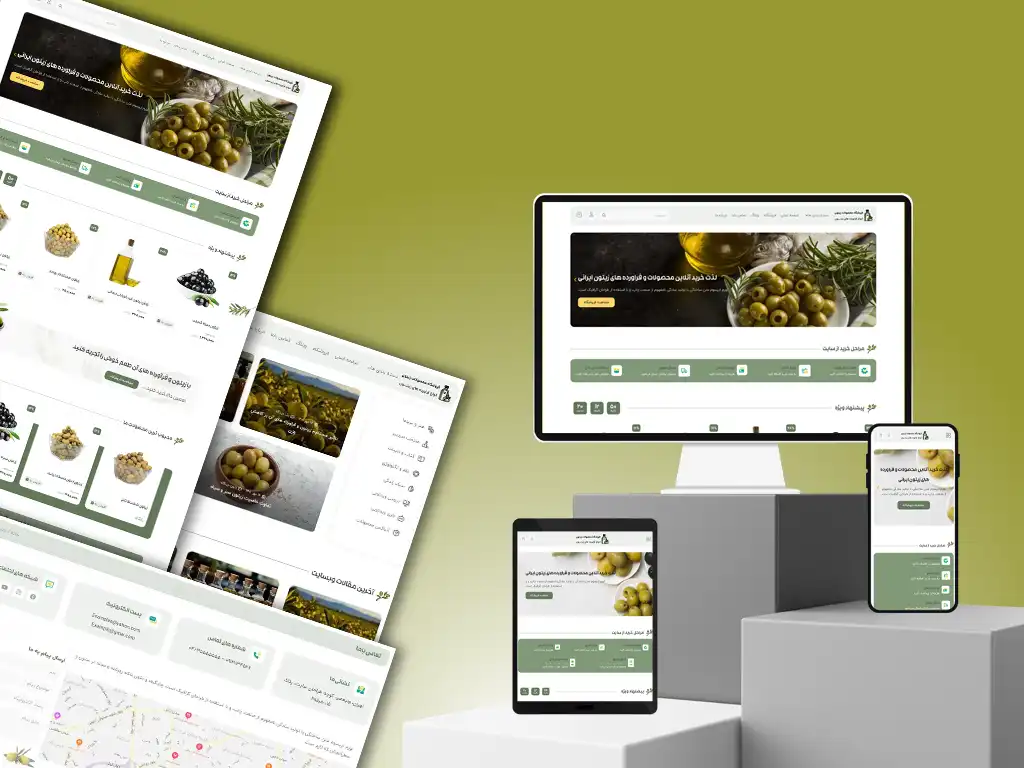
Olive online sales website design
Why is it necessary to design an online olive sales website?
In today’s world, where a single click can turn a visitor into a loyal customer, the traditional olive business—a symbol of health and authenticity—can no longer rely solely on physical storefronts or word-of-mouth referrals. But why is designing an online olive store not just an “option” for you, but a “strategic necessity”?
1. Breaking Geographical Barriers (From the Grove to Every Table) Your olives may be produced in the finest groves in the country, but without a website, your reach is limited to the neighborhood or city where you are located. By designing an online olive store, you shatter those borders. Now, a customer in the north or south of the country searching for organic, high-quality olives can find you directly with a simple Google search. You are no longer just a local vendor; you are a national supplier.
2. Storytelling and Trust Building (The Story of Every Olive) Olives are a product where quality lies in the details: the type of oil, the curing method, and the regional authenticity. In a physical store, you have limited time to explain these nuances. However, on your website, you can use high-quality imagery, short videos of the harvest process, and a dedicated “blog” section to narrate the story of your product’s authenticity. When a customer knows exactly how your olives travel from the tree to the package, trust is built—and this trust drastically increases the conversion rate from visitor to buyer.
3. Smart Management and Cost Reduction Eliminating intermediaries means higher profits for you and fairer prices for the customer. Designing an online olive store allows you to manage orders automatically, track inventory in real-time, and maintain a “digital storefront” that is open 24/7 without the burden of exorbitant rents for multiple physical locations.
In short, if you want to transform your olive brand from a simple product into a recognized name, a digital presence is the only way. Your website is your brand ambassador, showcasing the quality of your products through organization, beauty, and speed.
What are the key features in designing an online olive sales website?
To transform a website from a “simple catalog” into a “powerful sales machine,” you must understand that when customers buy food and organic products, they are searching for three things: trust, quality, and convenience. In essence, the design of an online olive store is only successful when it can convey the scent of fresh olives and the tactile sense of their quality through a screen.
Below, we examine the key features that every olive seller needs to conquer the digital market:
1. A Stunning Visual Showcase and User Experience (UX) The customer’s first encounter with your site is equivalent to “tasting” the product. Utilizing high-resolution, zoomed-in photos of the olive grains, elegant packaging, and a warm, natural color palette (olive greens and golds) conveys a sense of freshness. A responsive design (optimized for mobile) is also essential, as most grocery orders are placed via smartphones during moments of leisure.
2. Intelligent Filtration and Precise Categorization Your customers are diverse; one may be looking for salted green olives, another for black olives, and some for extra virgin olive oil. In the design of an online olive store, you must implement a filtering system that allows customers to find their desired product in seconds based on “Olive Type,” “Flavor,” “Package Weight,” or “Salt Level.”
3. Customer Reviews and Social Proof In the online food business, “the word of others” is more credible than “the word of the seller.” Creating a section for buyer reviews, product ratings, and the ability for customers to upload their own photos ensures that new visitors shop with greater confidence and peace of mind.
4. Order Management and Secure Payment Gateways A complex payment process can lead to abandoned shopping carts. Having a fast banking payment gateway, options for both retail and wholesale purchases, and an automated shipping cost calculator based on the destination city makes the shopping experience seamless and enjoyable.
5. “Our Story” Section and Educational Blog To convince a customer, you must demonstrate your expertise. Articles on topics such as “The Difference Between Extra Virgin Olive Oil and Regular Oils” or “The Health Benefits of Olives” do more than just boost your website’s SEO; they establish you as an authority and expert in the field.
Ultimately, technical features are merely tools. The real magic happens when these tools serve the authenticity of your product.
How does designing an online olive sales website help generate income?
Many olive producers imagine a website to be merely a “pretty advertisement,” but the reality is that designing an online olive store is actually building a “money-making machine” that works every second—even while you sleep or while you are in the grove supervising your trees. But how exactly does this process translate into real revenue in your bank account?
1. Eliminating Middlemen and Maximizing Profit (Direct-to-Consumer) In the traditional olive sales chain, brokers and middlemen swallow a huge portion of the profit. You sell the product cheaply, and the consumer buys it at a high price. By designing an online olive store, you implement a Direct-to-Consumer (D2C) model. Now, the product moves directly from your grove or warehouse to the customer. This means you can offer more attractive prices to the customer while significantly increasing your own profit margins.
2. Converting Visitors into Loyal Customers (Lifetime Value) Olives are a consumable, recurring product. Someone who is satisfied with the quality of your olives once will need them every month. In a physical store, a customer might forget your name, but on a website—through “User Accounts” and “Reminder SMS systems”—you can notify them: “It’s time to replenish your olive supply!” This strategy transforms your income from sporadic sales into a predictable, monthly recurring revenue stream.
3. Accessing Untapped Markets and Wholesale Sales (B2B) Your website is not just for selling single packages. With a professional online olive store design, you create a showcase to attract restaurants, hotels, and grocery stores across the entire country. A restaurant manager in another city can find you via a Google search and place bulk, high-volume orders that you would never have accessed through traditional methods.
4. Targeted Marketing and Reduced Advertising Costs Instead of distributing flyers or investing in expensive, aimless advertising, you use SEO (Search Engine Optimization) and PPC (Pay-Per-Click) to bring exactly the right people to your site—those who are searching for the phrase “buy organic olives” at that very moment. This means you are investing in people who already have a “strong intent to buy,” resulting in the highest conversion rates and the lowest acquisition cost per sale.
In Summary: Your website is no longer an expense; it is an investment that transforms your asset from a “agricultural product” into a “commercial brand.”
Other benefits of designing an online olive sales website...
Beyond increasing revenue and eliminating middlemen, designing an online olive store offers advantages that might seem contradictory to the world of agriculture at first glance. In reality, however, these are the very puzzle pieces that transform your business from a “simple producer” into a “small olive empire.” Let us explore the deeper layers of these benefits:
1. Data Management: Having a “Mental Map” of Your Customer In traditional sales, you don’t know exactly who your customer is, when they buy, or why they return. But by designing an online olive store, you gain access to a treasure trove of data. You might discover, for example, that demand for black olives spikes in November, or that customers in a specific city have a stronger preference for extra virgin olive oil. This information allows you to plan your production and inventory based on “hard facts” rather than “guesswork.”
2. Brand Equity and Social Standing (Professionalism) In today’s world, when a customer hears your brand name, the first thing they do is search for you on Google. The absence of a website is often interpreted by customers as being “technologically outdated” or having a “small-scale operation.” However, a sleek and professional online olive store grants you instant credibility. Your website is essentially your digital identity, telling the customer: “We believe in the quality of our product and have invested in our infrastructure to provide the best possible experience.”
3. Flexibility in Distribution and Testing New Products Suppose you want to launch a new product, such as “olives cured with a unique method” or “garlic and rosemary flavored olives.” In a physical store, you have to take a risk by stocking a large quantity in your display. On a website, however, you can first offer the product as a “pre-order” or in “limited quantities” to gather feedback. A website allows you to test the market without additional overhead and quickly replace products that do not perform well.
4. Sustainability and Independence from Environmental Crises Any event that prevents a customer from visiting your physical store—from heavy traffic to environmental restrictions—halts your sales. But with an online olive store, your business never closes. You are liberated from the dependency on a physical location, making your business resilient against environmental fluctuations.
Ultimately: Your website is not just a tool for selling; it is a bridge connecting the “authentic traditions of the olive grove” with the “speed of the modern world.”
In your opinion, wouldn’t implementing a “Monthly Olive Subscription” system (where a set amount of olives is delivered to the customer every month) double the attractiveness of your website?
Main page:
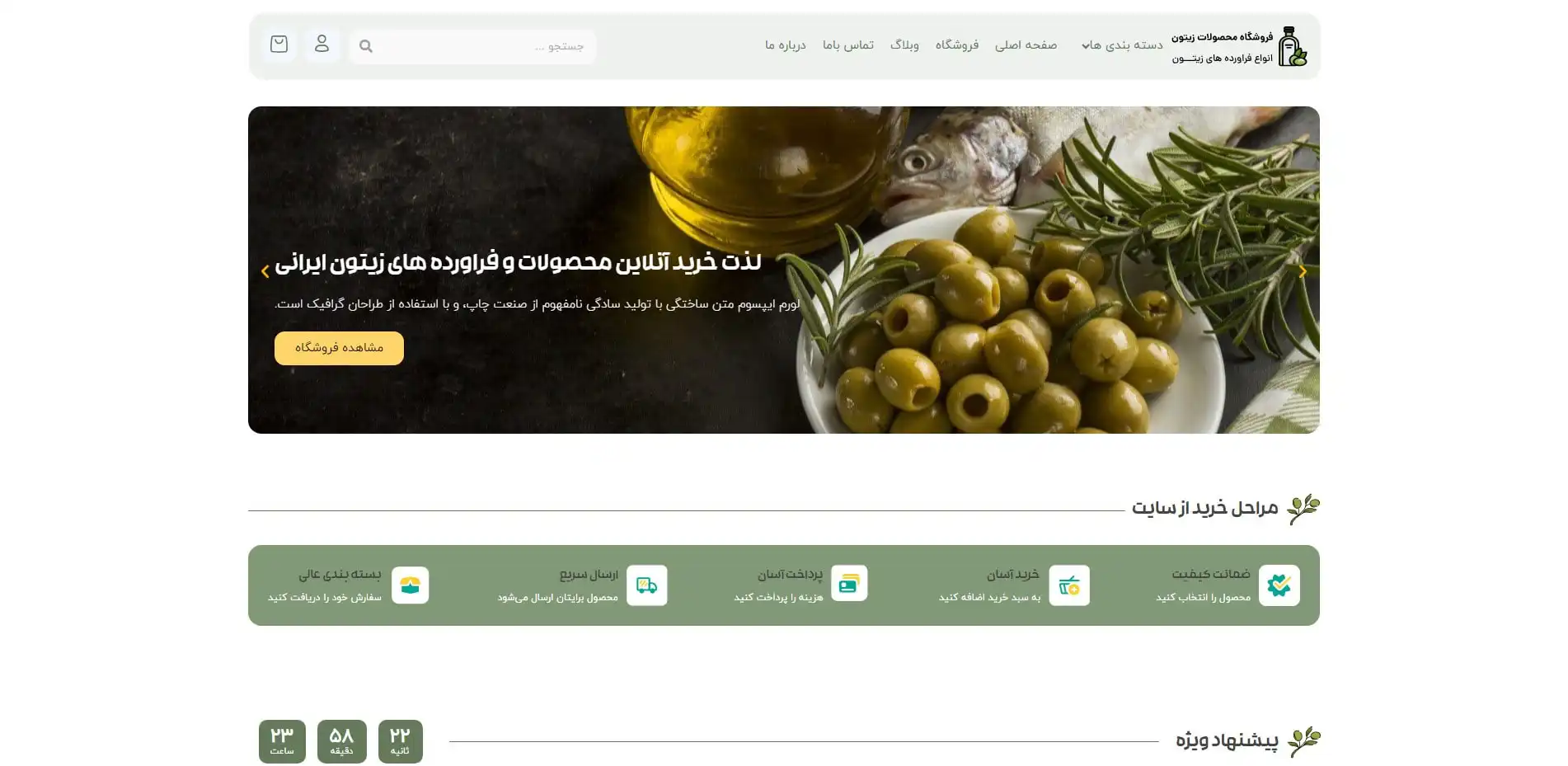
Your own page
The home page of your website is exactly like the “entrance gate to an olive grove”; it is where the customer decides at first glance whether to enter and stay, or change their path. In the design of an online olive store, the home page should not merely be a list of products; instead, it must be a “visual and emotional experience” that captures the customer’s trust in less than five seconds.
To ensure your home page becomes a customer-attracting magnet, it must possess these three fundamental pillars:
1. The Hero Section (The First Encounter): The Magic of Imagery and Slogans The topmost section of the site should begin with a stunning, high-quality image of fresh olives alongside golden oil, perhaps with a glimpse of the grove. A short and impactful slogan (such as: “The Authenticity of Virgin Olives, From Root to Table”) should be centered. In this section, place a clear Call to Action (CTA) button, such as “Browse Organic Products,” to guide the customer toward a purchase quickly and without confusion.
2. Visual Storytelling and Rapid Access (Simplicity Meeting Beauty) The customer should not have to scour the entire site to find their desired product. In the design of an online olive store, using “attractive graphic icons” for categories (for example, an icon for green olives, one for black olives, and one for olive oil) on the home page shortens the path to purchase. Additionally, include a section for “Best Sellers” or “Special Offers of the Month” to reduce the customer’s hesitation in choosing a product.
3. Trust Hooks (Converting Visitors into Buyers) Since the customer cannot taste the product, you must sell them “trust.” On the home page, dedicate small sections to the following:
- Quality Assurance: Symbols guaranteeing freshness and organic certification.
- Customer Reviews: Short, authentic testimonials from previous buyers.
- Competitive Advantages: (Fast shipping, hygienic packaging, direct-from-grove pricing).
A successful home page in the design of an online olive store is a balance between “visual art” and the “psychology of sales.” When a user feels they are dealing with a brand that is professional yet intimate, they will journey into the inner pages of the site with greater enthusiasm.
Store section:
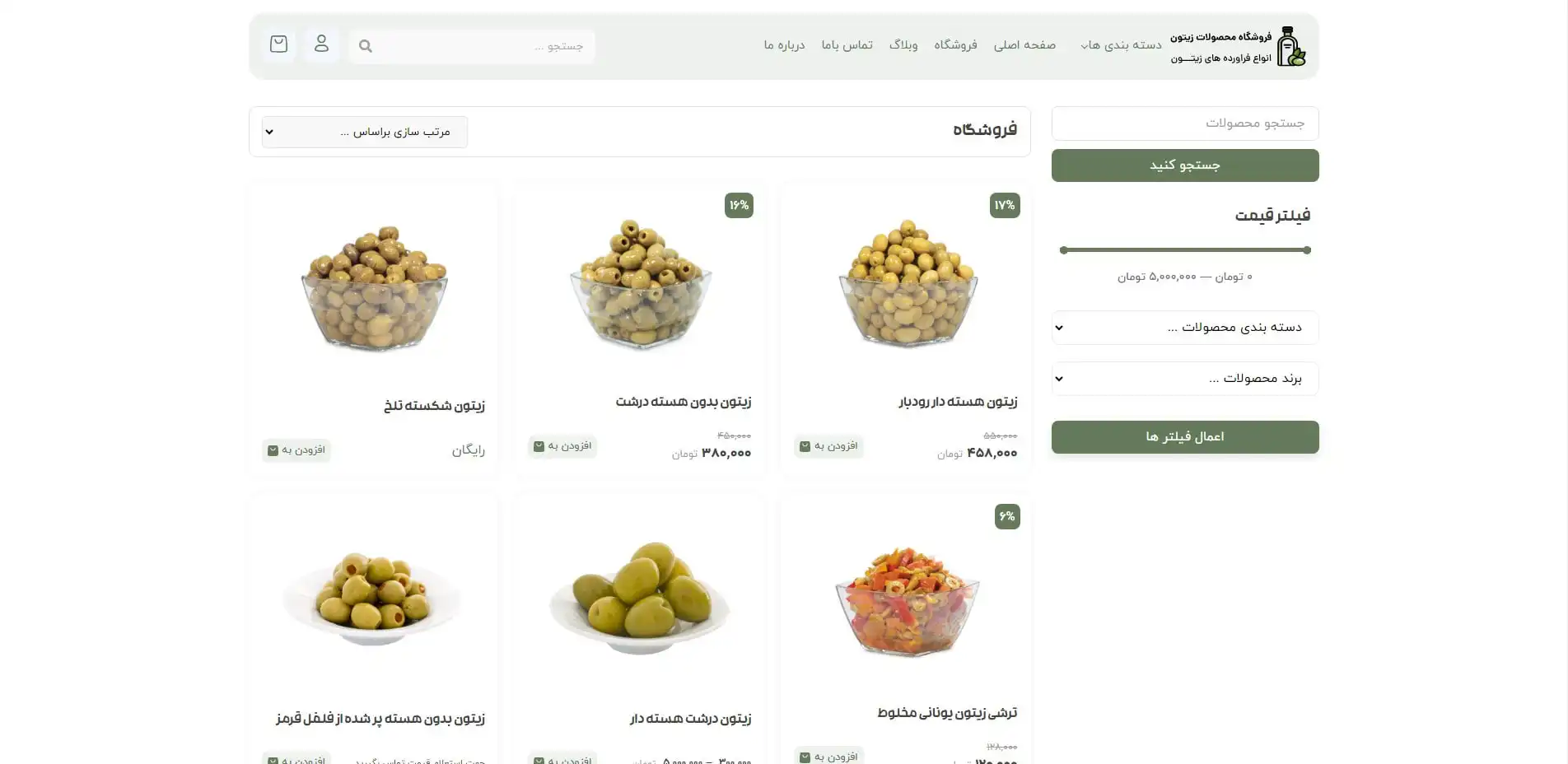
Main section of the store page
If the home page is the “entrance gate to the grove,” the store section is essentially your “sales counter and showcase”—the place where the customer touches the product (digitally), compares it, and finally decides whether these olives deserve a place on their table. In the design of an online olive store, the shop section should not resemble a dry list of commodities; rather, it should feel like a delightful shopping experience in a traditional yet modern organic market.
To ensure your store section achieves a high Conversion Rate, you must focus on these three core pillars:
1. “Speaking” and Tempting Product Cards Every product in the store must have an attractive “ID card.” Instead of simply writing “Green Olives 500g,” use titles that evoke emotion (for example: “Crunchy Organic Green Olives – Fresh Year’s Harvest”). Utilizing multiple images (a close-up of the olive texture and a wide shot of the packaging) directly on the store page eliminates customer hesitation. Furthermore, placing labels such as “Best Seller,” “Limited Stock,” or “Special Discount” on the cards creates a sense of urgency, encouraging the customer to click.
2. Intelligent Filtration (The Shortest Path to the Cart) No one enjoys flipping through ten pages to find a specific type of olive oil. In the design of an online olive store, you must implement an advanced filtering system in the sidebar. Customers should be able to filter products based on “Product Type,” “Flavor” (salty, bitter, sweet), “Oil Content,” or “Price Range.” The shorter the path to the product, the lower the probability of cart abandonment.
3. The Product Page: A Space for Persuasion When a user clicks on a product, they enter the final stage of decision-making. Here, descriptions should be “human and descriptive,” not merely technical. Instead of writing “Weight: 1kg,” write: “One kilogram of the purest olive grains, cured using traditional methods without chemicals to gift you the authentic taste of nature.” Adding a “Complementary Products” section (for example, suggesting olive oil alongside a green olive purchase) will drastically increase your average order value (AOV).
The store section is the beating heart of your revenue. If you combine user convenience with visual beauty in the design of an online olive store, the customer will not only buy once but will become an ambassador for your brand.
Blog (News and Articles)
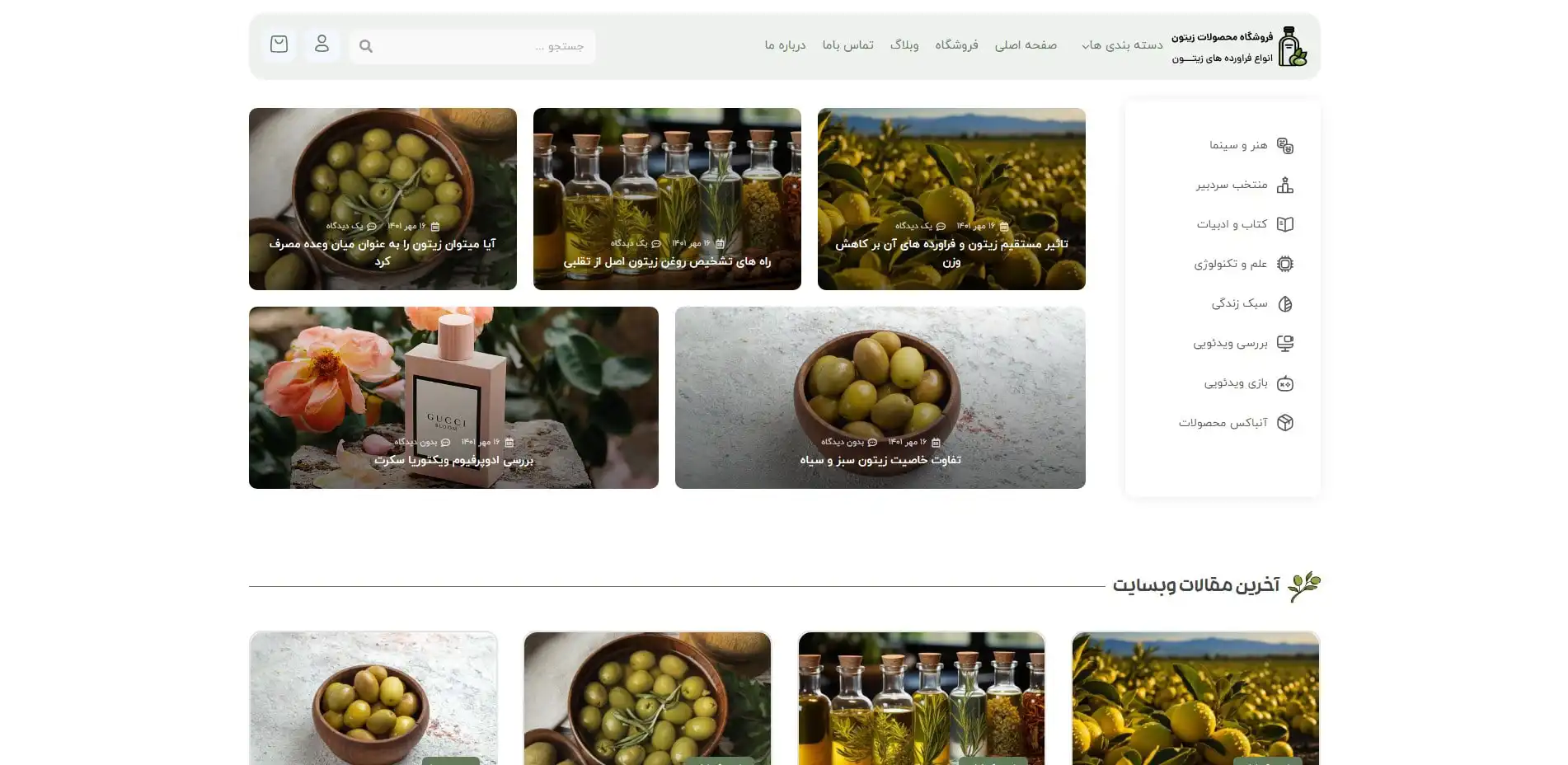
Professional article classification
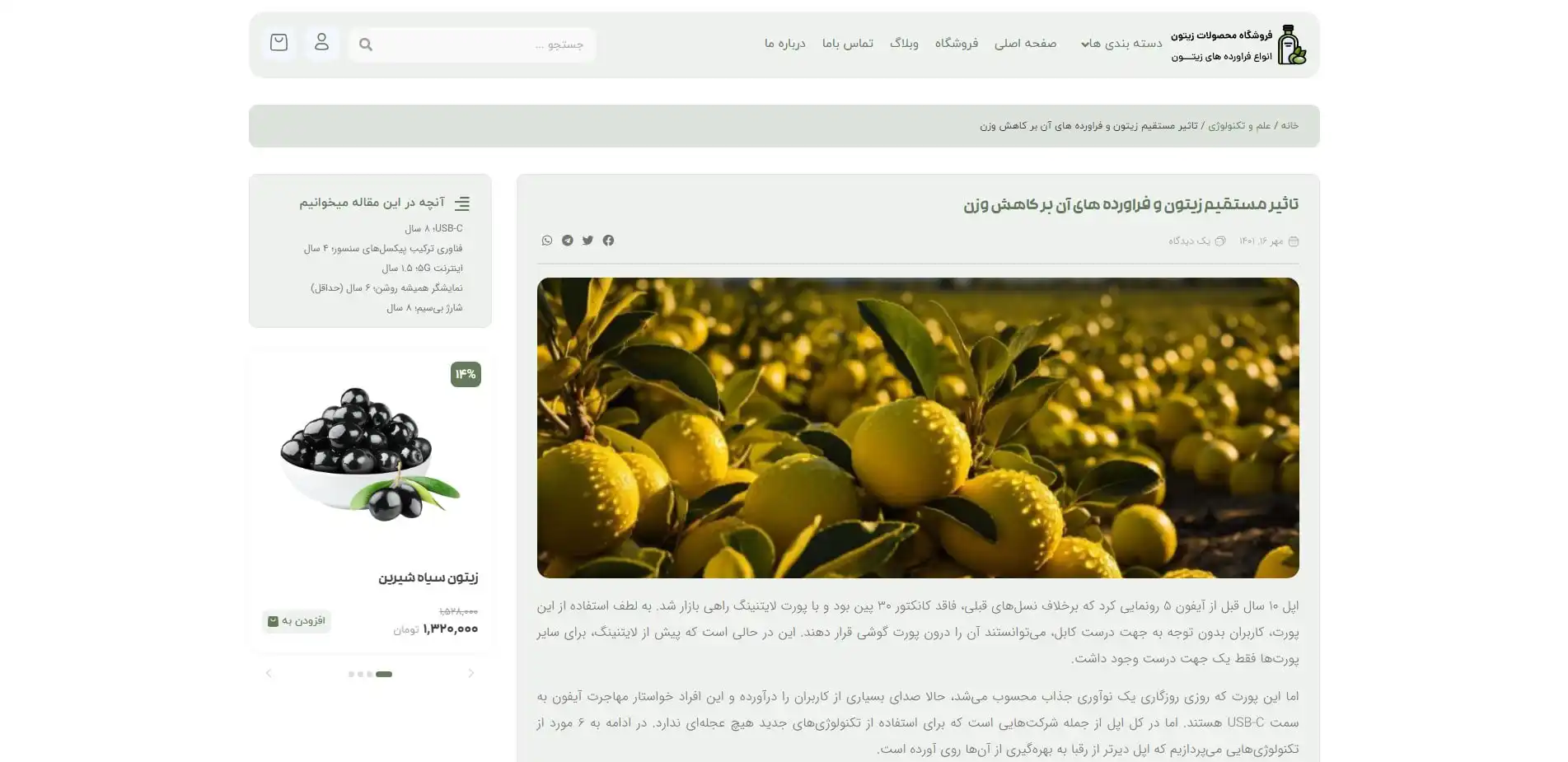
Professional article classification
Many businesses view a blog as merely a section for publishing simple news or repetitive articles; however, in the design of an online olive store, a blog is actually the “caring and expert consultant” who stands beside the customer, guiding them to purchase with absolute confidence. If the store section is the “body” of the site, the blog is its “soul and brain,” granting your brand personality, authority, and expertise.
But how does a strategic blog transform into a tool for attracting customers and increasing sales?
1. Converting the “Searcher” into a “Buyer” (The Power of SEO) Most users have questions in their minds before buying; for example: “What is the best type of olive for a specific diet?” or “How can I distinguish genuine olive oil from counterfeits?” When you answer these questions in your blog, Google introduces you as an authority. In essence, designing an online olive store coupled with an active blog ensures that those who may not intend to buy yet—but are currently researching—find your site through search engines and eventually transform into loyal customers.
2. Building Trust Through Education (Education-Based Marketing) Olives and olive oil are products whose quality cannot be fully determined at first glance. A blog is an opportunity to show the “behind the scenes.” Articles titled “The Olive Harvesting Stages in Our Grove” or “The Secrets of Authentic Olive Curing” prove to the customer that you are not just a simple trader, but an expert who is passionate about their product. This transparency breaks down the wall of customer hesitation and replaces it with trust.
3. Stimulating Appetite and Creating Need (Content Commerce) The blog is where you can sell your product in the form of a “solution.” Instead of simply trying to sell olives, write an article titled: “5 Mediterranean Salad Recipes Using Extra Virgin Olive Oil.” Within this article, place a purchase link for the exact olive oil used in the recipe. At this point, you are no longer “selling” something; rather, you are offering the customer a “delicious experience.”
In the design of an online olive store, a blog is the bridge between your expertise and the customer’s needs. A blog written in a human, honest, and useful language transforms your site from a cold digital storefront into a community that people trust for both learning and shopping.
Body pages (About Us, Contact Us, and FAQs)
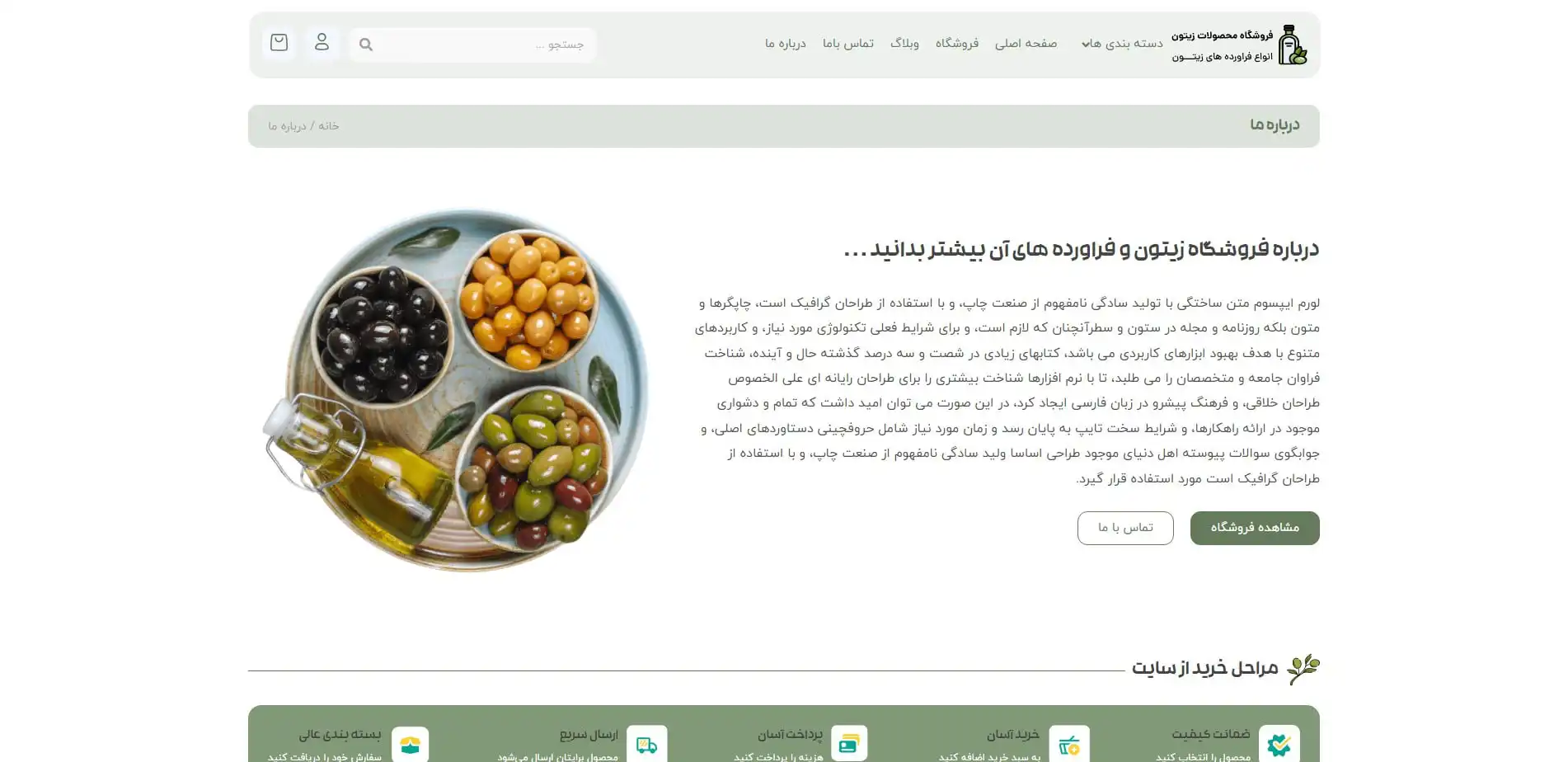
Minimalist and user-friendly About Us page
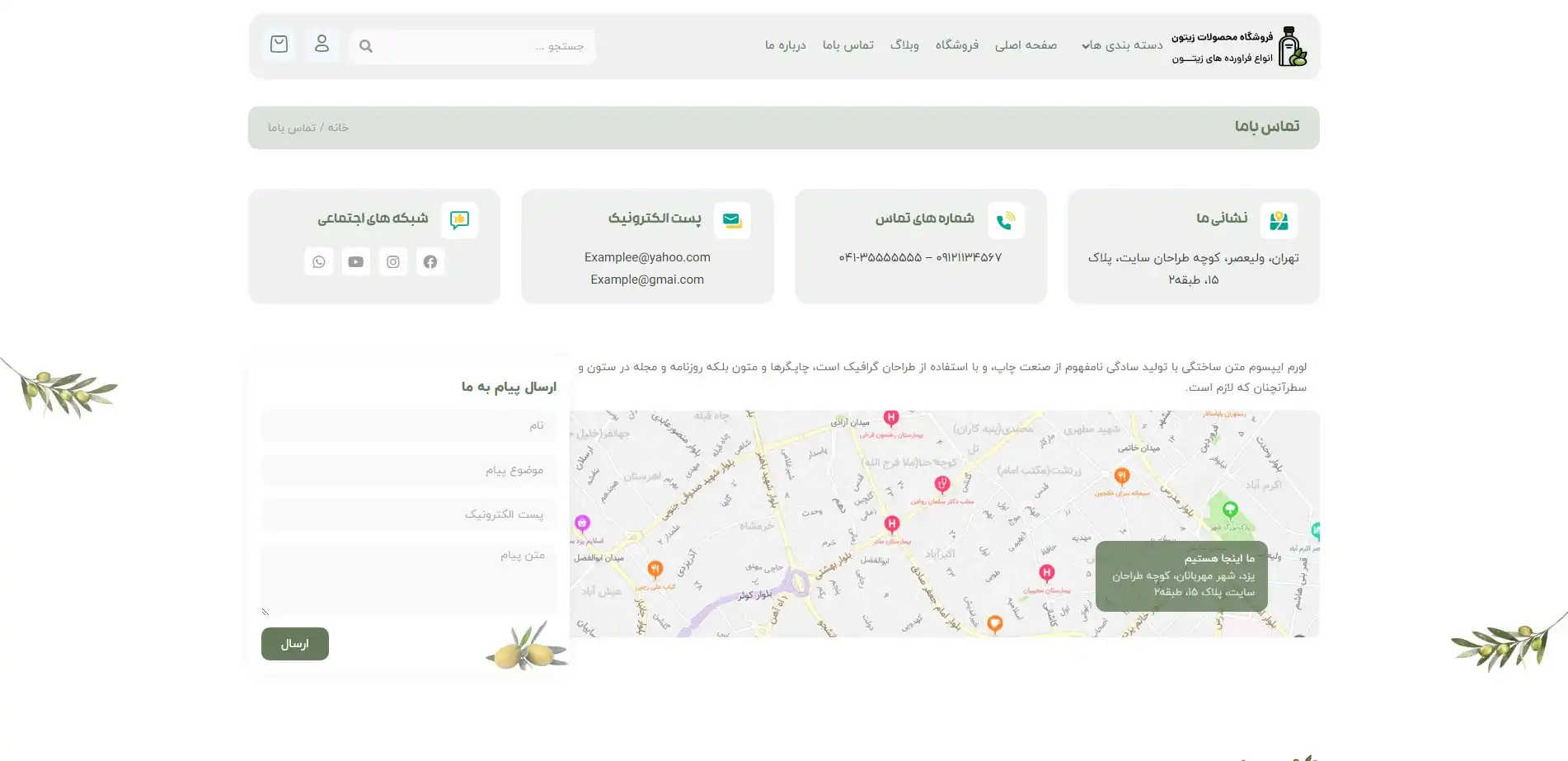
Minimalist and user-friendly About Us page
In the world of digital commerce, many managers view the “About Us,” “Contact Us,” and “Frequently Asked Questions” (FAQ) pages as secondary or unimportant. However, the truth is that these pages act as the customer’s “scale of trust.” In the design of an online olive store—where the product is directly linked to human health and taste—the customer wants to know before paying: “Who am I buying from? Is this person real? And if a problem arises, where can I find them?”
Let us examine how to transform these pages into powerful tools for persuasion:
1. The “About Us” Page: Turning History into Storytelling Customers don’t want to know that you are a company with “X” years of experience; they want to hear your story. In the design of an online olive store, this page should evoke the smell of the grove’s soil and the scent of olives. Speak of the previous generations who planted the trees, the love for the land, and the effort to preserve the product’s authenticity. When a customer feels that a passionate and authentic human being stands behind the website, they no longer use price as the sole criterion; instead, they buy into your “value” and your “story.”
2. The “Contact Us” Page: A Fast and Transparent Communication Bridge The greatest fear of online buyers is getting lost in cyberspace. This page must convey a sense of absolute security. In addition to a contact form, it is essential to include a Google Map (if you have an office or grove), a direct phone number, a precise address, and links to social media. The easier and more transparent your accessibility is, the more the customer feels that you are not “hidden” and that you take full responsibility for your product.
3. The “Frequently Asked Questions” (FAQ) Page: Removing the Final Barriers to Purchase This page is, in effect, your “24-hour support team.” Every question a customer has that might hold them back from purchasing (for example: “Are the olives cured without chemicals?” or “How does shipping to other cities work?”) should be answered here in a friendly and convincing tone. Addressing common concerns in the design of an online olive store allows the customer to cast aside their doubts and click the “Place Order” button in the shortest time possible, without needing to make a phone call.
These pages are the “foundation” of your website’s trust. If your store is the showcase, these pages are your “guarantee.”
Other features for the online olive sales website design
- Responsive Design
- Direct Bank Gateway
- Receive the National Trust Symbol
- Ability to insert bilingual or multilingual content
- Ability to define brand and category pages
- Smart inventory and warehouse management
- SEO Base (ability to get rank 1 on Google)
- Unlimited capabilities (number of brands, categories, labels, etc.)
